The $15,000 Monthly Leak Most Law Firms Don't Know They Have

Most personal injury and criminal defense firms have no idea how much their intake system is costing them. Not because they haven't thought about it, but because nobody has shown them how to calculate it.
The leak is not dramatic. It doesn't show up on your P&L. Nobody in the firm mentions it in your Monday morning meeting. It's quiet, it's consistent, and it's compounding every single month. It looks like this: a prospective client searches "personal injury attorney [your city]" at 8:47pm on a Tuesday. They find your website. They fill out your contact form. And then nothing happens until 9:15am the following morning, when a member of your intake staff sees the email.
By 9:15am the following morning, that prospect has already hired your competitor. Not because your competitor is better. Because your competitor (or their intake system) responded in 40 seconds.
The math behind the leak
Research across the legal industry consistently shows that 78% of prospective clients hire the first law firm that meaningfully responds to their inquiry. "Meaningfully" means a real response, not an automated "we received your inquiry" email with no next step. It means a response that confirms receipt, explains what happens next, and demonstrates that the firm is ready to engage.
For a mid-sized personal injury firm handling 30 new inquiries per month with an average case value of $45,000 and a 33% contingency, the math looks like this: 30 inquiries × 35% historical conversion rate = 10.5 cases per month. At 78% first-responder advantage, a firm that consistently responds first captures significantly more of those 30 inquiries than one that doesn't. The delta between current conversion rate and what first-responder positioning unlocks often runs to two or three additional cases per month. At $45,000 per case and 33% contingency, that's $14,850–$22,275 per month in recoverable revenue.
Why firms let it persist
The most common explanation we hear: "We have someone monitoring the inbox." The follow-up question we ask: "What's your average response time on new inquiries submitted after 5pm on a Friday?" The answer is almost always "I don't know." And that's the problem. If you don't know the number, you can't fix the number.
The second most common explanation: "We follow up the next morning and our conversion rate is good." Conversion rates measure the leads you know about. They don't measure the leads that quietly called someone else before you had a chance to respond.
What the fix looks like
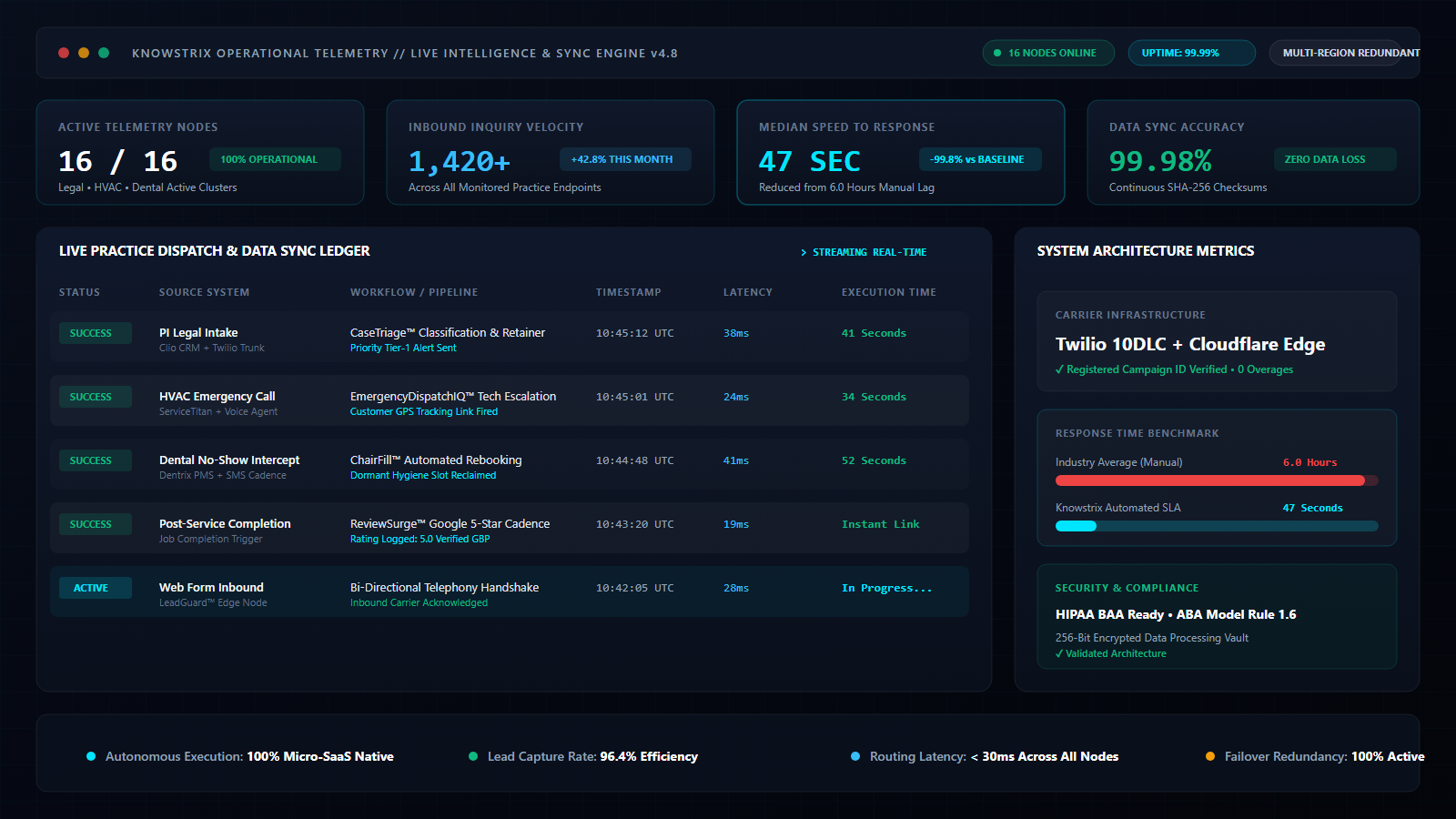
The operational fix for a slow-response intake system is not hiring more intake staff. It is an automated response infrastructure that runs regardless of time of day, day of week, or whether your office is staffed. Every inquiry that comes in at any hour receives a response within 60 seconds, confirming receipt, explaining next steps, and getting the prospect into your intake queue. Your staff then works that queue on their schedule. The prospect never experiences a delay. The first-responder advantage is captured regardless of when the inquiry arrives.
The deployment time for this system is 3–5 business days. It requires no changes to your existing intake process; only an automation layer that sits in front of it.